Bee & Wasp Removal Services
Safe, professional bee hive relocation and wasp nest removal for homes and businesses across Delhi NCR. Licensed technicians, full protective equipment, same-day service available.
Do You Have a Bee or Wasp Problem at Your Home or Business?
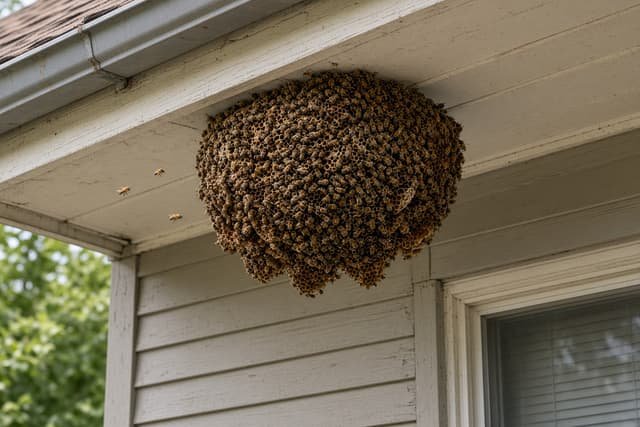
A bee hive or wasp nest on your property is more than an inconvenience — it is a genuine safety risk. Unlike the common perception, bees and wasps become highly aggressive when they perceive a threat to their nest, and stings from a disturbed colony can cause severe allergic reactions (anaphylaxis) requiring emergency medical treatment. Wasps in particular — including common wasps, hornets, and yellow jackets — can sting multiple times and release alarm pheromones that trigger mass attack behaviour from the surrounding colony. Children, elderly residents, and anyone with insect venom allergies face the highest risk from an untreated nest.
Bee and wasp nests are a regular occurrence across Delhi NCR's residential colonies, housing societies, and commercial buildings. Honey bee hives frequently establish under roof eaves, inside wall cavities, in water tank enclosures, and on balconies and window frames — particularly during spring and early summer when swarms are actively seeking new nesting sites. Paper wasp nests and hornet nests are commonly found under roof overhangs, inside unused rooms, in garden sheds, and around air conditioning units. Monsoon season in Delhi also triggers increased wasp activity as nests expand rapidly in warm, humid conditions.
Attempting to remove a bee hive or wasp nest without proper protective equipment, experience, and the correct treatment products is extremely dangerous. Disturbing a nest without full protection can provoke an immediate mass defensive response, resulting in hundreds of stings. Common DIY approaches — spraying with household insecticide, covering the nest, or attempting physical removal — are generally ineffective and significantly increase aggression risk. Many amateur removal attempts result in the colony relocating deeper into the structure, making professional removal more difficult and costly. Read more: DIY vs Professional Pest Control: When to Call an Expert →
Niramay Pest Control provides safe, professional bee removal and wasp nest removal across Delhi NCR. Our licensed technicians arrive with full protective gear, professional-grade insecticide products for wasp nests, and the equipment and experience required for safe honey bee hive relocation. Every removal is conducted following a structured assessment protocol — we do not simply spray and leave. We identify the species, assess the nest size and location, apply the correct treatment method, and where appropriate, remove the physical nest structure to prevent re-colonisation.
Book a Free Inspection →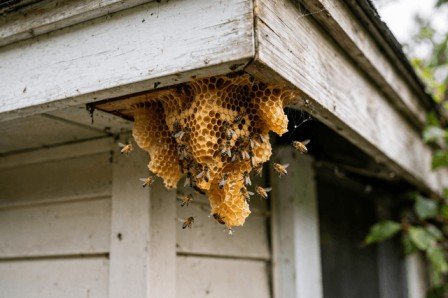
Signs You Have a Bee or Wasp Nest on Your Property
Bee and wasp nests are often established before homeowners notice them. Watch for these warning signs — early identification allows for faster, lower-risk removal.
Noticing a significantly higher number of bees or wasps flying around a specific area of your property — particularly concentrated around a wall gap, roof eave, tree, or garden structure — is the clearest early sign of an established or forming nest nearby. Activity is typically highest in the warmer parts of the day.
Honey bee hives appear as irregular, layered wax comb structures — golden-brown in colour — typically found in sheltered, enclosed spaces. Paper wasp nests are grey, papery, and umbrella-shaped, usually open at the bottom and attached under overhangs. Hornet nests are large, enclosed, football-shaped grey paper structures, often found in trees, attics, or wall voids.
A persistent low buzzing or humming sound coming from inside a wall, ceiling, or roof void — particularly one that intensifies during warm parts of the day — strongly suggests a honey bee colony has established inside the building structure. This requires professional assessment before any drilling or intervention.
Yellowish or brown staining appearing on interior walls or ceilings, sometimes accompanied by a faint sweet smell, may indicate a honey bee colony established within a wall or roof cavity. As the hive grows and wax combs fill with honey, seepage through building materials can occur — causing structural damage if left untreated.
Observing bees or wasps repeatedly entering and exiting through a specific small gap, crack, or hole in brickwork, fascia boards, window frames, or roof tiles indicates an established colony inside the structure. Do not attempt to seal the entry point yourself — this can force the colony deeper into the structure and significantly increase removal difficulty.
If bees or wasps become noticeably aggressive — flying directly at people or animals — when approaching a particular part of your garden, roof, or building exterior, this is a strong indicator of a nearby nest in active defensive mode. Maintain distance and contact a professional immediately rather than attempting to investigate.
Noticed any of these signs? Don't delay — book a free inspection or call us now.
Our Bee & Wasp Removal Process
Niramay Pest Control uses a structured, safety-first approach to every bee and wasp removal. Treatment method depends on the species identified — honey bee hives are relocated wherever possible, while wasp and hornet nests are treated with targeted professional insecticide. Our technicians carry full protective gear on every visit and follow a documented protocol to ensure safe, effective results.
Honeybee Hive Relocation
Why relocation rather than extermination?
Honey bees (Apis mellifera and Apis cerana, the two most common species in Delhi) are ecologically vital pollinators and are not inherently aggressive unless their hive is threatened. Where the hive location and accessibility allow, Niramay technicians perform humane hive relocation rather than extermination — transferring the colony to a suitable alternative location away from the property.
Our honey bee relocation process
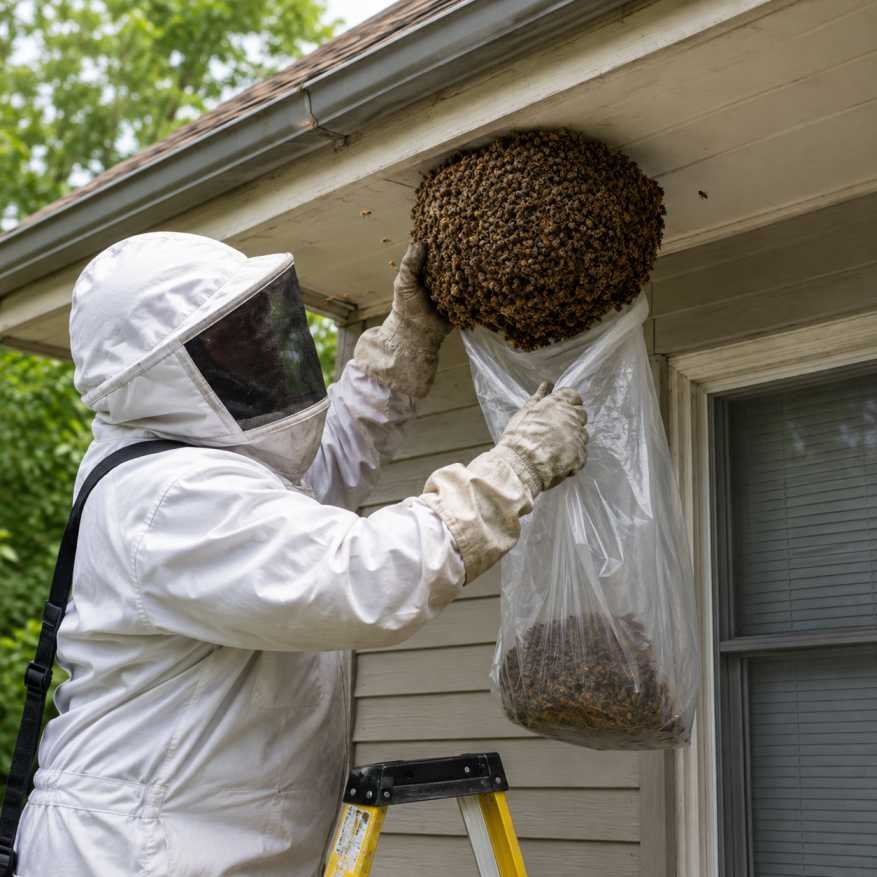
Our technician arrives in full protective gear including a bee suit, gloves, and veil. We identify the hive location, size, and access route. Using a smoker to temporarily calm the colony, we carefully remove the hive structure — including the honeycomb and queen — and transfer it to a transport box for relocation. The removal area is then treated to deter scout bees from re-establishing in the same location.
When is relocation not possible?
If the hive is inaccessible within a sealed wall cavity or structural void, if the colony is extremely large and aggressive, or if the property requires immediate clearance, professional extermination using approved insecticide products may be necessary. Your Niramay technician will advise on the most appropriate treatment option after assessment.
Wasp Nest Extermination
Why extermination rather than relocation?
Unlike honey bees, wasps (including common wasps, paper wasps, hornets, and yellow jackets) do not produce honey or wax, are significantly more aggressive, and their nests cannot be relocated intact. Professional extermination using approved insecticide — applied directly into or around the nest — is the safe, effective, and standard treatment for all wasp and hornet nest removal.
Our wasp nest removal process
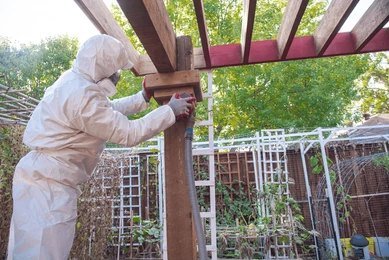
Our technician arrives in full protective gear and assesses the nest size, location, and species. Professional-grade insecticide is applied directly into the nest entrance or onto the nest structure using a lance or injection equipment, ensuring the product reaches the colony interior. The insecticide acts on contact and through ingestion as wasps return to the nest, typically resulting in full colony elimination within 24–48 hours. Once the colony is confirmed eliminated, the physical nest structure is removed where accessible to prevent re-colonisation by a new colony the following season.
Hornet nests
Asian hornets (Vespa velutina) and European hornets (Vespa crabro) are occasionally found in Delhi NCR, particularly in older properties with mature trees and roof voids. Hornet nests require the same treatment approach as wasp nests but with additional precautions given the larger body size and venom volume per sting. All Niramay technicians are trained in hornet nest identification and treatment.
Need urgent bee or wasp removal in Delhi NCR?
Same-day service available. Call or WhatsApp us now to confirm availability in your area.
📞 Call NowHoney Bee Hive vs Wasp/Hornet Nest — Quick Comparison
| Feature | Honey Bee Hive | Wasp / Hornet Nest |
|---|---|---|
| Appearance | Golden-brown wax comb | Grey papery structure |
| Aggression level | Moderate (defensive only) | High (readily aggressive) |
| Ecological value | Very high (pollinators) | Moderate |
| Treatment method | Relocation preferred | Extermination |
| Treatment duration | 1–3 hours (accessible hive) | 24–48 hrs to full elimination |
| Physical nest removal | Yes (included) | Yes (after colony elimination) |
| Can they sting multiple times? | No (honey bee dies after stinging) | Yes (repeated stings) |
How Our Bee & Wasp Removal Works — Step by Step
Every Niramay bee removal and wasp nest removal follows a five-step protocol, designed for maximum safety and complete resolution.
Our technician arrives and conducts a safe, thorough assessment of the nest location, size, and species. Correct identification is essential — honey bee hives and wasp nests require completely different treatment approaches. We identify entry and exit points, assess structural access requirements, and confirm the safest treatment method before beginning.
Based on the assessment, we provide a fully itemised quote covering the treatment method (relocation or extermination), any access requirements, number of visits needed, and post-treatment follow-up. No work begins until you have approved the quote — no hidden charges, no pressure.
Before treatment begins, our technician dons full protective gear — bee suit, gloves, and protective veil. Residents are advised to remain indoors and keep windows and doors closed during the treatment. Any pets in garden areas are moved to safety. The treatment perimeter is confirmed before we proceed.
For honey bee hives: the hive is carefully opened, calmed with smoke, and transferred to a transport box with the queen for relocation. For wasp and hornet nests: professional insecticide is applied directly into the nest entrance or structure, ensuring full colony penetration. The treatment area is secured and residents are briefed on post-treatment precautions.
Once the colony is eliminated (24–48 hours for wasp/hornet nests, immediate for honey bee relocation), the physical nest structure is removed where accessible. The removal area is treated with a residual deterrent to reduce the likelihood of re-colonisation. We provide aftercare advice and confirm our follow-up availability if needed.
Bee & Wasp Removal Cost in Delhi NCR
Bee and wasp removal costs vary based on the species involved, nest size and location, accessibility, and whether relocation or extermination is required. We provide a free on-site assessment and a fully itemised quote before beginning any work — no surprises, no hidden charges. View our full pest control pricing guide →
Honey bee hive relocation typically requires more technician time and specialist equipment than wasp nest extermination, and is priced accordingly. Your technician will confirm the species and recommended treatment during the free assessment visit.
Nests in easily accessible locations — under roof eaves, on garden structures, or on exterior walls — are quicker and less costly to treat than nests inside wall cavities, roof voids, or building interiors, which may require access equipment or minor masonry work.
Larger, more established nests — particularly honey bee hives that have been building for several months — require more time, product, and equipment to treat safely. Nest size is assessed during the free inspection visit.
Residential removals are priced based on nest location and size. Commercial properties, housing societies, and multi-storey buildings may require access equipment or coordination with building management, and are quoted based on a site assessment.
Where same-day or emergency bee and wasp removal is required — for example, where a nest poses an immediate risk to residents or customers — we prioritise the visit and apply standard treatment pricing. Contact us to confirm same-day availability in your area.
If scout bee activity is detected after the initial treatment, a follow-up visit is included within the agreed treatment guarantee period. Persistent or inaccessible infestations may require a second treatment, which is quoted separately after the first visit assessment.
Approximate Starting Prices (indicative — final quote after site assessment)
- Wasp nest removal (standard accessible location)from ₹1,500
- Hornet nest removalfrom ₹2,000
- Honey bee hive relocation (accessible)from ₹2,500
- Honey bee hive removal from wall/roof cavityfrom ₹3,500
- Commercial / housing societyCustom quote after site survey
All prices are indicative. Final itemised quote provided after free on-site assessment. No commitment required after inspection.
Bee & Wasp Removal Across Delhi NCR
Niramay Pest Control provides professional bee and wasp nest removal across all of Delhi NCR. Honey bee swarms are most active in Delhi NCR during February to May, as colonies split and establish new nests. Wasp and hornet activity peaks during the summer and early monsoon months (June–September), when warm, humid conditions support rapid colony growth. Housing societies, independent bungalows, and commercial properties across all Delhi zones report regular bee and wasp nest issues — particularly in older properties with accessible roof voids, cavity walls, and established garden trees.
In over 12 years serving Delhi NCR properties, we have handled everything from honey bee swarms on balcony railings in Rohini's residential societies to large hornet nests in roof voids of independent houses in South Delhi. Housing societies with mature trees in areas like Dwarka, Vasant Kunj, and East Delhi's older sectors frequently report bee swarming activity during spring. Wasp nests under AC unit covers and roof overhangs are a particularly common complaint across West Delhi and North Delhi residential colonies. Whatever your location, Niramay's technicians can reach you — often on the same day — with the right equipment and treatment for complete bee and wasp removal near you in Delhi NCR.
Why Choose Niramay Pest Control for Bee & Wasp Removal?
Every Niramay technician arrives equipped with a professional bee suit, gloves, and protective veil for all bee and wasp removal jobs — regardless of nest size. Your safety and theirs is non-negotiable: we do not cut corners on protective standards.
We correctly identify the species — honey bee, paper wasp, common wasp, hornet — before choosing a treatment method. This matters: honey bee hives and wasp nests require entirely different approaches, and misidentification leads to ineffective or unnecessarily destructive treatment.
Where the hive location and colony size allow, we prioritise the relocation of honey bee hives rather than extermination, reflecting both ecological responsibility and best practice in bee removal. We work to preserve the colony and rehome it safely away from your property.
All insecticide products used for wasp and hornet nest treatment are WHO-approved, professionally formulated for stinging insect control, and applied by trained technicians at manufacturer-specified rates. We do not use amateur or over-the-counter spray products.
Bee and wasp nests can become urgent situations quickly — particularly if a nest is discovered near a child's play area, a main entrance, or a commercial premises. We prioritise urgent removal calls and aim to provide same-day bee removal service across Delhi NCR where availability allows.
Every Niramay bee and wasp removal includes a results guarantee. If the colony is not fully eliminated after our treatment protocol, or if scout bee activity continues at the treated location, we return and re-treat at no additional cost.
What Our Customers Say About Our Bee & Wasp Removal Service
"We had a massive honey bee hive forming under our roof eave in Rohini. It was terrifying — thousands of bees and we couldn't use the main entrance. Niramay came the same day, suited up properly, and relocated the entire hive safely. No bees harmed, no stings, and the area was cleared within two hours. Incredibly professional."
"A large wasp nest had formed inside the false ceiling of our shop in Laxmi Nagar. We were getting stung regularly and couldn't keep the shop open safely. Niramay treated the nest in the evening after closing time, and by the next morning all wasp activity had stopped completely. Highly recommend their wasp nest removal service."
"There was a hornet nest in the garden of our housing society in Dwarka that had been growing for weeks. Several residents had been stung. Niramay sent a technician the same day, identified it as a hornet nest, treated it professionally, and removed the nest structure completely. Fast, safe, and thorough."
Read All Reviews →
Other Pest Control Services in Delhi NCR
Bees and wasps aren't the only pest challenge Delhi NCR homeowners face. Niramay provides a complete range of residential and commercial pest control services. View all services →
Frequently Asked Questions About Bee & Wasp Removal
Have a question not answered here? Call or WhatsApp us — we typically respond within minutes.
Don't Risk a Sting — Get Safe Bee & Wasp Removal Today
Don't put your family or staff at risk from an untreated bee hive or wasp nest. Book a free, no-obligation inspection with Niramay Pest Control today — same-day bee removal and wasp nest removal service available across Delhi NCR.